
Behind the Science: Problem Solving Inside a Fast-Paced CDMO
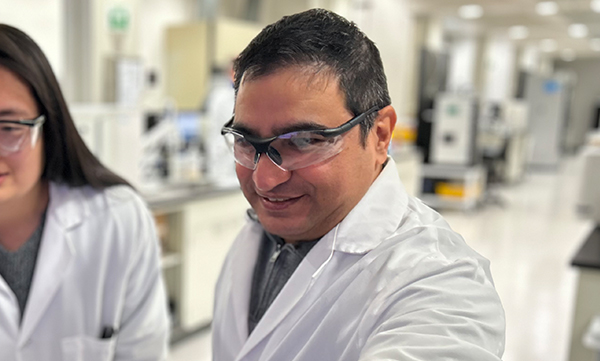
When Gilbert Martinez, PhD talks about his work at AGC Biologics, he describes a world where the science moves fast, challenges appear without warning, and every day brings a new puzzle to solve.
AGC Biologics is a leading global biopharmaceutical Contract Development and Manufacturing Organization (CDMO) providing services for protein-based biologics and advanced therapies. As a Process Development Fellow with more than 15 years in the field, Martinez sits at the intersection of experimentation, troubleshooting, and partnership with both established biopharma leaders and some of the most ambitious young biotech companies in the industry.
The CDMO environment comes with constant variety, and Martinez supports programs at every stage, from early development through commercial production. “The CDMO space is a lot different than other biotech companies,” Martinez explained. “If you enjoy taking on new challenges on a daily basis, it’s great. You learn so much because you’re put in positions where you have to solve problems at so many different stages.”
Martinez’s day-to-day work spans problem-solving across multiple stages of development. He often steps into projects to diagnose issues, guide experimental decisions, and help teams understand what the data might be signaling. With early-stage clients in particular, many come with innovative therapeutics but limited resources, and Martinez finds it energizing to help them move their programs forward, helping to find solutions for even the most complex molecules. These clients bring passion to pushing boundaries, and AGC Biologics brings scientific depth and infrastructure. The result is a highly collaborative partnership where Martinez helps them navigate unfamiliar territory while troubleshooting in real time.
Another part of Martinez’s work involves collaborating across departments and meeting with upstream and downstream groups within AGC Biologics to understand how the biological manufacturing process is unfolding and where problems can arise. He encourages his team to ask questions early, often, and across disciplines. “I tell my team regularly: I could be wrong. You need to challenge me, and we need to challenge each other,” he said. “Good science happens when people feel safe asking hard questions.”
He also reminds his team not to overlook the simplest tools. One of his most shared stories comes from an early-career role when a raw material change was causing major product failures. While colleagues leaned toward complex analytical methods, Martinez and his manager stepped back. A basic UV spectrophotometer, something used in freshman chemistry, revealed a key kinetic parameter that all the advanced methods would have overlooked. The experience reinforced his belief that elegant, simple experiments often provide the clearest answers, especially when guided by a solid hypothesis.
“Sometimes the simplest experiment is the one that gives you the clearest answer. You don’t necessarily need the newest instrument to solve the problem. You need a hypothesis and the willingness to start with the basics,” Martinez explained.
That mindset is reflected in the way AGC Biologics teams work together. Understanding what another department is trying to achieve allows scientists to anticipate issues, interpret data more accurately, and avoid disconnects. Martinez describes the culture as friendly, communicative, and deeply collaborative: “People here are very willing to help, learn from you, or teach you,” Martinez said. “That openness makes all of our work better.”
Mentoring – a passion area for Martinez – is another piece of his role that ties directly back to the science. He starts by asking team members what they want from their careers, then helps them shape goals that support both their personal growth and the company’s business objectives. He also sets expectations about the reality of scientific research. Some of it is arduous, but it matters because the molecules they produce ultimately reach patients.
“We’re producing molecules that are going into human beings,” Martinez said. “We need to make sure we’re doing things the right way and safely.”
Living in the Pacific Northwest adds another layer to his experience. He appreciates the region’s natural beauty, moderate seasons, and easy access to the outdoors. But the ethos of the area matters too: “The Pacific Northwest has this friendliness and willingness to help people,” Martinez said. “It’s a unique mindset, and you feel it across the biotech community here.”
Ultimately, for Martinez, the heart of the work is simple: science is problem solving. Success comes from curiosity, communication, and the willingness to start with the basics. And when those pieces come together, the impact reaches far beyond the lab.
Ready to advance your biotech career in Washington state? Follow AGC Biologics on LinkedIn to learn more about the company.
Are you a developer seeking support on a project? Learn more about the AGC Biologics Seattle site.
Sponsored by Life Science Washington and AGC Biologics